One of the most frustrating things in life is realizing that the person standing in your way might actually be you.
And the tricky part is that most of us don't even recognize when we're doing it.
We see this all the time when men come to The Balanced Man Retreat. They arrive wanting something to change in their lives, but when we create enough space for them to slow down and examine their patterns, the stories they've been telling themselves for years begin to look a little different. They start to recognize how some of their own behaviours are contributing to the very situations they're trying to escape.
I think this is far more common than most of us realize, and I've certainly caught myself doing it.
We call it self-sabotage, but I don't think it's always as simple as deliberately getting in our own way. Often, there's a part of us that genuinely wants to move forward, while another part is doing everything it can to keep things familiar and predictable.
And until we begin recognizing that conflict, we can spend years repeating the same patterns while wondering why nothing seems to change.
Why We Keep Repeating What Doesn't Work
What makes self-sabotage difficult to recognize is that the behaviour usually serves a purpose, even when it's creating problems in our lives.
Imagine a man who genuinely wants a stronger relationship with his wife. He knows they need to communicate better, and he wants to feel more connected to her. But whenever a difficult conversation comes up, he becomes defensive or withdraws into his work.
In that moment, avoiding the conversation gives him relief. He doesn't have to feel vulnerable, admit something uncomfortable, or risk being misunderstood. But the distance between them continues to grow, and eventually he feels frustrated with himself because he knows he's contributing to the problem.
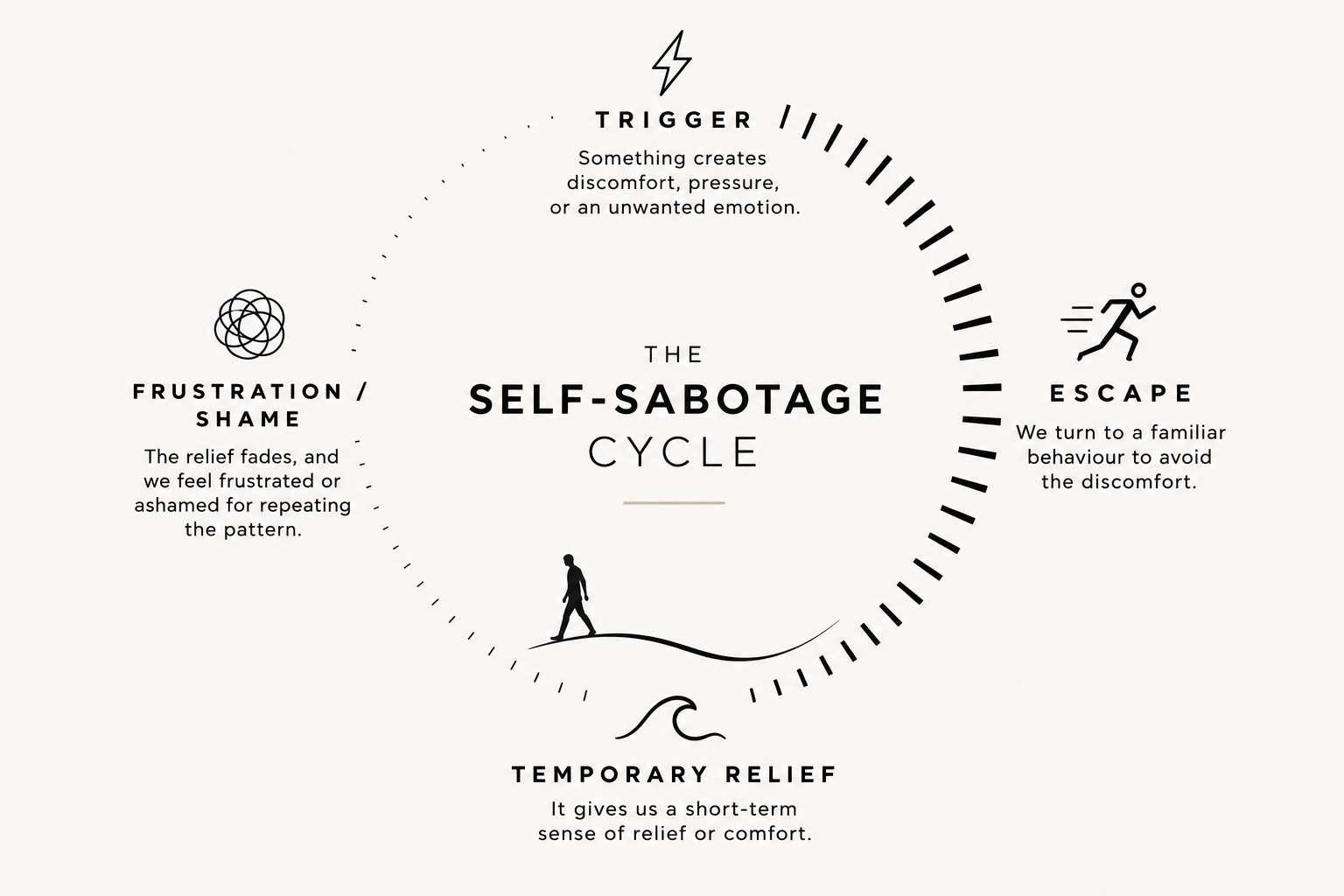
This is how the cycle works. Something triggers discomfort, we escape into a familiar behaviour, experience temporary relief, and then feel frustrated or ashamed because we've repeated something we promised ourselves we would change.
That frustration can become the next trigger, and around we go.
The important thing to recognize is that the behaviour isn't necessarily random. Somewhere along the way, we learned that it helped us deal with something uncomfortable. The problem is that what gives us relief in the moment can be the very thing keeping us stuck over the long term.
The Two Things We Want
Another layer of self-sabotage is that we can genuinely want two conflicting things at the same time.
This one hit home for me during our last retreat.
I've become aware of how much I like having control over the businesses I'm involved in. I want them to grow, and I want more freedom in my life, but there's also a part of me that wants to be involved in every decision and make sure things are done the way I would do them.
Those two desires don't always work very well together.
If I want greater freedom, I have to become more comfortable trusting other people and allowing them to take ownership. That means accepting some uncertainty, which isn't always comfortable for me.
Sometimes the thing we consciously want is in direct conflict with something we're unconsciously trying to protect. We want growth, but we also want certainty. We want deeper relationships, but we don't want to risk being vulnerable.
Until we recognize both sides, it's like driving with one foot on the gas and the other on the brake.
Awareness Creates the Opportunity to Change
So how do we begin breaking these patterns?
I think the first step is to stop beating ourselves up long enough to understand what's actually happening.
The next time you catch yourself repeating a behaviour you don't like, pay attention to what happened immediately before it. What were you feeling? What were you trying to avoid? And what did that behaviour give you in the moment?
Maybe it gave you relief, control, or a temporary escape from something you didn't want to face.
Once you recognize that, you have an opportunity to respond differently.
You might still feel uncomfortable having that conversation with your wife, but that doesn't mean you need to have all the answers or immediately resolve the disagreement. Sometimes simply acknowledging what's happening inside you is enough to interrupt the pattern. You might say, "I'm noticing I'm getting defensive right now, and I'm not entirely sure why." That small moment of honesty creates an opening. Instead of shutting down or reacting the way you always have, you're allowing yourself to be seen, even in the middle of the discomfort.
And sometimes the solution is much more practical. If your environment keeps pulling you toward a behaviour you're trying to change, make that behaviour harder to repeat. We don't need to turn every bad habit into some deep psychological mystery.
The point is to develop enough awareness that you can begin making conscious choices instead of constantly reacting from old patterns.
This takes practice, and there will be times when you slip back into familiar behaviours. That's part of learning, not evidence that you've failed.
You're Not Something That Needs Fixing
This is one of the fundamental beliefs behind The Balanced Man.
We're not bringing men together because there's something wrong with them that needs to be fixed. And we're certainly not there to tell them how they should live their lives.
We create an environment where men can step outside their everyday routines, examine their patterns, and begin discovering what's actually driving their decisions.
Sometimes those discoveries are uncomfortable. You might realize that something you've blamed on other people or external circumstances is actually a pattern you've been contributing to for years.
But there's also something incredibly empowering about that realization.
Because once you can see your role in creating a situation, you can begin taking responsibility for changing it.
For me, this is what true self-awareness looks like. It's not about constantly trying to become a better version of ourselves because we believe who we are isn't enough. It's about having the courage to look honestly at our patterns, understand why we've developed them, and recognize that we don't have to keep living from those same unconscious behaviours. We're not trying to fix who we are. We're learning to understand ourselves at a deeper level so we can make more conscious choices about how we want to live.
Self-sabotage loses some of its power when we stop fighting ourselves and start understanding ourselves.
And the more aware we become of those patterns, the less control they have over the direction of our lives.
Written By

Ahren Cadieux
Ahren is the Co-Founder of The Balanced Man, and is passionate about exploring mindset, personal growth, and the power of brotherhood.